
Asymmetric information is "where one party in an economic transaction has access to more or better information than the other party." Market failure is "the failure of markets to produce at the point where community surplus (consumer surplus + producer surplus) is maximised." This socially optimal output is where marginal social benefit equals marginal social cost (MSB = MSC), so that resources are allocated efficiently. Free markets reach this point only if buyers and sellers can judge the true benefits and costs of what they trade. When one side knows more than the other, the less-informed side makes decisions based on incomplete information, so the quantity traded can differ from the socially optimal quantity. Asymmetric information creates market failure in two main ways. Adverse selection arises before a transaction: one party has hidden information about the quality or risk of what is being traded, so the transaction takes place on uneven terms. Moral hazard arises after a transaction: one party changes their behaviour in a way the other party cannot observe, because some of the cost of that behaviour now falls on the other party.
The market for used cars shows how adverse selection causes market failure. Sellers know whether their car is high quality or a poor-quality "lemon", because they have driven and maintained it. Buyers cannot easily tell the difference, especially when faults are technical and hidden, such as a worn gearbox. Because buyers cannot observe the quality of any particular car, a rational buyer is only willing to pay a price that reflects the average quality of cars in the market.
This average price is too low for owners of high-quality cars, whose cars are worth more than the price buyers will offer. Many of these sellers withdraw from the market instead of selling below their car's true value. It is, however, an attractive price for owners of lemons, who receive more than their cars are worth. As high-quality cars leave the market, the average quality of the remaining cars falls. Buyers expect this, so the price they will pay falls further, which drives out more of the better cars. In an extreme case, only lemons are left, and the market for good used cars may disappear entirely.
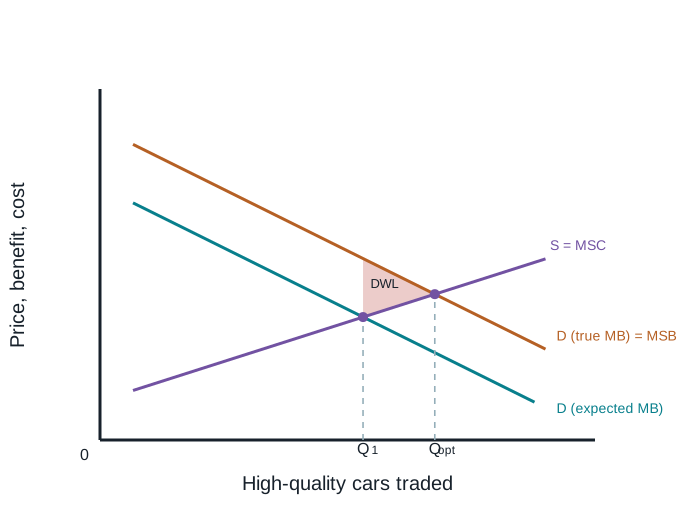
This is a market failure because mutually beneficial transactions do not take place. Suppose a buyer would value a good car at $10 000 and its owner would accept $8 000. Trading would create $2 000 of social surplus. But because the buyer cannot verify quality, they offer only the average price, perhaps $6 000, so the sale never happens and this surplus is lost. The demand for high-quality cars is based on the expected marginal benefit of an average car, not the true marginal benefit of a good car. Buyers' demand therefore lies below the true MSB of high-quality cars, so too few are traded, and at the market quantity MSB > MSC. Resources are underallocated to high-quality cars, community surplus is not maximised and a welfare loss results. At the same time, buyers who end up with lemons pay more than those cars are worth. Their decisions are based on a false estimate of benefit, so resources are also misallocated towards poor-quality cars.
Figure 1 shows the market for high-quality used cars, with price on the vertical axis and quantity on the horizontal axis. An upward-sloping supply curve is labelled S = MSC. A demand curve labelled D (true MB) = MSB crosses it at the socially optimal quantity Q*. A second demand curve, labelled D (expected MB), lies below it, because buyers value each car only at the average quality of the market. The market settles at Q1 < Q*, where D (expected MB) crosses S. The triangle between MSB and MSC from Q1 to Q* is shaded as the welfare loss.
The insurance market shows how moral hazard causes market failure. Moral hazard occurs when one party takes risks but does not face the full costs of those risks, because the costs are borne by the other party. Before buying insurance, a person bears the full cost of any loss, so they have a strong incentive to take care. For example, a car owner without theft insurance is careful to lock their car and park it in safe places. Once they are insured, the insurance company pays for most of any loss, so the cost of carelessness to the individual falls, and they may become less careful about protecting their car. The buyer of insurance knows how they intend to behave after the contract is signed, but the insurer cannot observe this. The insurer therefore cannot perfectly adjust the premium to the policyholders who take less care.
This creates allocative inefficiency. Because insured people take more risks, more cars are stolen and more claims are made than the insurer expected when it set its price. The insurer's costs rise above what it expected. To protect themselves, insurers raise premiums, limit the cover they offer or refuse to insure some people. Less insurance is therefore bought and sold than the socially optimal amount. Many people who would value insurance at more than the cost of providing it, given careful behaviour, cannot obtain it on those terms, so mutually beneficial transactions do not take place. Resources are underallocated to insurance services, so at the market quantity MSB > MSC and community surplus is not maximised.
Moral hazard also misallocates resources in the market for the insured activity itself. The insured person weighs the benefit of a risky action, such as saving time by not locking up, against their private cost, which is now only part of the expected loss. Society, however, still bears the full cost, because stolen or damaged goods must be replaced using scarce resources. Risky behaviour continues beyond the point where its marginal social benefit equals its marginal social cost, which is a further source of welfare loss.
Asymmetric information creates market failure because the less-informed party cannot make decisions based on the true benefits and costs of a transaction. With adverse selection, hidden information about quality drives high-quality goods such as good used cars out of the market, so too few are traded and MSB > MSC. With moral hazard, hidden behaviour after a transaction means insured people do not bear the full cost of their risk-taking. Insurers protect themselves by raising premiums and restricting cover, so too few resources are allocated to insurance, and too many are used in risky activities. In both cases the market does not produce where MSB = MSC, community surplus is not maximised and a welfare loss results.