
Profit is total revenue minus total cost. Profit maximisation "is producing at the level of output where profits are greatest: where marginal revenue equals marginal cost." Standard economic theory assumes that firms are rational producers whose goal is to maximise profit. This is a desirable goal in most cases. Profit rewards the owners who have invested in the firm, provides funds for future investment and allows the firm to survive in a competitive market. However, firms can also have alternative business objectives that may conflict with maximising profit, such as corporate social responsibility (CSR), market share and growth, and satisficing. This essay argues that profit maximisation is the main objective of most firms most of the time. The word "always", however, cannot be supported, because firms often give up some profit, at least in the short run, to pursue other goals.
The theory of profit maximisation: A firm maximises profit by producing the output where marginal revenue (MR) equals marginal cost (MC). Marginal revenue is the additional revenue from selling one more unit of output, and marginal cost is the additional cost of producing it. If MR is greater than MC, producing one more unit adds more to revenue than to cost, so profit rises and the firm should increase output. If MC is greater than MR, the last unit adds more to cost than to revenue, so profit falls and the firm should reduce output. Profit can only be at its highest where MR = MC, provided MC is rising at that point, because at any other output a change in output would increase profit.
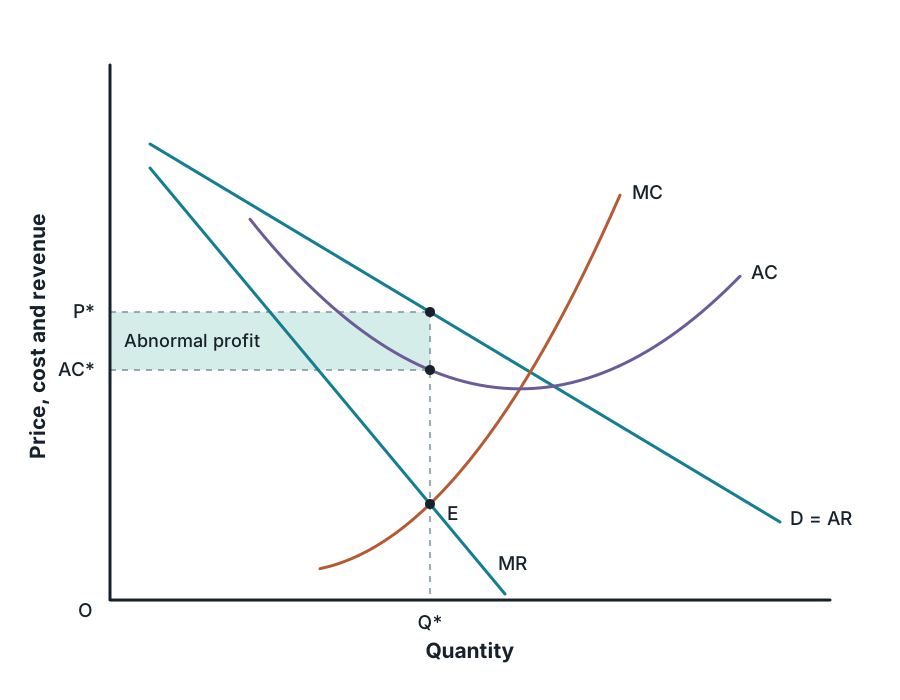
Figure 1 shows a firm with market power. Because the firm faces a downward-sloping demand curve, D = AR, it must lower its price to sell more units. MR therefore lies below AR, because selling an extra unit requires a lower price on all the units the firm could otherwise have sold at the higher price. The firm produces Q*, where MR = MC at point E. It then charges the highest price consumers are willing to pay for that quantity, P*, which is read from the demand curve, not from MR. At Q*, average cost is AC*, which is below P*. The firm therefore earns abnormal profit of (P* − AC*) per unit, and total abnormal profit is the shaded rectangle with height P* − AC* and width Q*. Abnormal profit can persist in the long run if barriers to entry prevent new firms from entering the market and competing it away. Note that MR = MC only identifies the output with the greatest profit. Whether this profit is abnormal depends on the position of the AC curve.
The benefits of profit maximisation: There are strong reasons why firms seek to maximise profit. First, abnormal profits give firms the ability to finance research and development (R&D). Firms in perfect competition earn only normal profit in the long run and therefore have less scope to fund R&D from persistent abnormal profits. Firms with market power can fund large R&D projects, which lead to new products and technologies that benefit consumers. Barriers to entry and patents also allow these firms to keep the profits from their innovations, which gives them an incentive to innovate in the first place. Apple, for example, reported US$112.0 billion in net income in its 2025 financial year and spent US$34.55 billion on R&D. Second, profit rewards the owners who take the risk of investing their capital. A firm that consistently gives up profit may find it harder to attract investment and may lose shareholders' support. Third, profitable firms can grow and achieve economies of scale, lowering average costs, which can mean lower prices for consumers. In competitive markets, firms that do not earn enough profit may not survive at all. These reasons support the view that profit maximisation is the main objective of most firms. In practice, however, firms rarely know their exact MR and MC curves, so they cannot calculate the precise MR = MC output. At most, they can aim for it.
Corporate social responsibility: Corporate social responsibility is "an approach taken by firms where they attempt to produce responsibly/ethically towards the community and environment." This can include avoiding polluting activities, using environmentally sound practices, refusing to exploit child labour and donating to charities. CSR implies that profit maximisation is not being pursued when a socially responsible action costs the firm more than it brings in. If a firm chooses an option with higher costs or lower revenue than the profit-maximising option, it gives up profit to benefit society.
CVS Health, one of the largest pharmacy chains in the United States, stopped selling cigarettes and other tobacco products in all its stores in 2014. The company estimated that this meant giving up about US$2 billion in annual sales. CVS explained the decision by saying that selling tobacco conflicted with its purpose of helping people improve their health. The lost sales were revenue, not profit. The decision supports a social objective, but does not by itself establish how total profit changed, because other sales and costs could also change.
However, CSR may not always conflict with profit. Tragakes notes that a firm's revenue depends not only on its costs but also on its reputation, since consumers may avoid buying from firms they consider unethical. CVS was trying to establish itself as a healthcare company, and leaving tobacco may have strengthened its relationships with health-conscious customers and healthcare partners. Studies of whether CSR raises or lowers profit have been inconclusive. This suggests that firms may sometimes use CSR as a long-run route to profit, rather than as an alternative to it.
Market share and growth: Market share is the percentage of total sales in a market earned by a single firm. Growth maximisation means making the firm as large as possible, for example in terms of sales or customers. To increase market share or grow quickly, a firm may cut its prices, spend heavily on advertising or invest in new products. Each of these can lower profit: lower prices may reduce revenue per unit, while advertising and R&D increase costs. In terms of Figure 1, a firm that expands output beyond Q* to win more customers is producing units where MC is greater than MR, so each additional unit reduces profit. Choosing to produce there means that profit maximisation is not being pursued.
Amazon is a clear example. In its 1997 letter to shareholders, Amazon stated that it would prioritise market leadership and long-term growth over short-term profitability. That year its sales rose by 838% to US$147.8 million, but it reported a net loss of US$27.6 million, because it spent heavily on expanding its customer base, its range of products and its distribution network. Amazon deliberately accepted losses in exchange for growth.
This example also shows the limits of the argument. Growth was intended to bring economies of scale, market power and higher profits in the future. Tragakes notes that firms pursue growth partly because economies of scale and market power increase their profitability. Amazon was therefore not abandoning profit, but giving up short-run profit in exchange for higher expected long-run profit. The view that firms always seek profit maximisation is therefore more convincing if it refers to long-run profit rather than profit in every period.
Satisficing: Satisficing "occurs when entrepreneurs endeavour to cover their opportunity costs, but do not push themselves significantly further, even though they might be able to earn higher profits." Herbert Simon argued that a large modern firm is made up of many groups, such as owners, managers, workers and shareholders, each with its own objectives. These objectives may conflict, so the firm cannot maximise any single one. Instead, it aims for a satisfactory level of profit together with satisfactory results for its other objectives. A satisficing firm therefore stops short of the highest attainable profit by choice, because pushing further would mean sacrificing other goals.
Chick-fil-A, a US fast-food chain, has closed all its restaurants on Sundays since its founder, Truett Cathy, opened his first restaurant in 1946. The company says this gives employees a day to rest and reflects the founder's religious values. A purely short-run profit-maximising firm might open on Sundays if the extra revenue exceeded the extra cost. Chick-fil-A may give up some short-run profit to meet other objectives: the owners' values and staff wellbeing. Because it still earns a satisfactory profit, it has no need to push for the maximum.
The example has limits. Chick-fil-A is a private, family-controlled firm, and its owners can choose objectives other than profit without pressure from outside shareholders. Satisficing may be less common in large public companies, where shareholders can sell their shares or replace managers if profits are lower than they could be. Also, the Sunday closing may help attract and keep staff, and it is part of the company's brand, so even this choice may not cost as much profit as it first appears.
Profit maximisation remains the most important single objective for most firms. Profit rewards owners, finances investment and R&D, and is necessary for firms to survive in competitive markets. The MR = MC model is therefore a useful prediction of how firms behave. The view that firms will always seek to maximise profit is, however, too strong. CVS gave up about US$2 billion in annual sales while pursuing a social objective, Amazon accepted losses for growth, and Chick-fil-A forgoes Sunday trading for its owners' values. Many of these alternatives may still serve profit in the long run, through a better reputation, economies of scale or a stronger brand. This suggests that the more accurate view is that firms generally seek long-run profit, but often give up short-run profit to pursue other objectives. How far they do so depends on who controls the firm, how much competitive pressure it faces and how long a time horizon its owners take.