
Price elasticity of demand (PED) is defined as a measure of the responsiveness of the quantity demanded of a good or service when there is a change in its price. It is calculated as PED = (% change in Qd) ÷ (% change in P). Primary commodities are "raw materials that are produced in the primary sector". This means goods that are extracted or harvested directly from natural resources, such as agricultural products like wheat and coffee, and products of extractive industries like crude oil, coal and metals. Manufactured products are "goods that have been processed by workers". They are produced by labour working with capital and raw materials, such as cars, computers and televisions.
Demand is price elastic when PED > 1. This means a change in price then causes a more than proportionate change in quantity demanded. Demand is price inelastic when PED < 1. A change in price then causes a less than proportionate change in quantity demanded. The demand for primary commodities tends to be price inelastic (PED < 1), while the demand for manufactured products tends to be more price elastic (PED > 1).
Figure 1 compares the two cases.
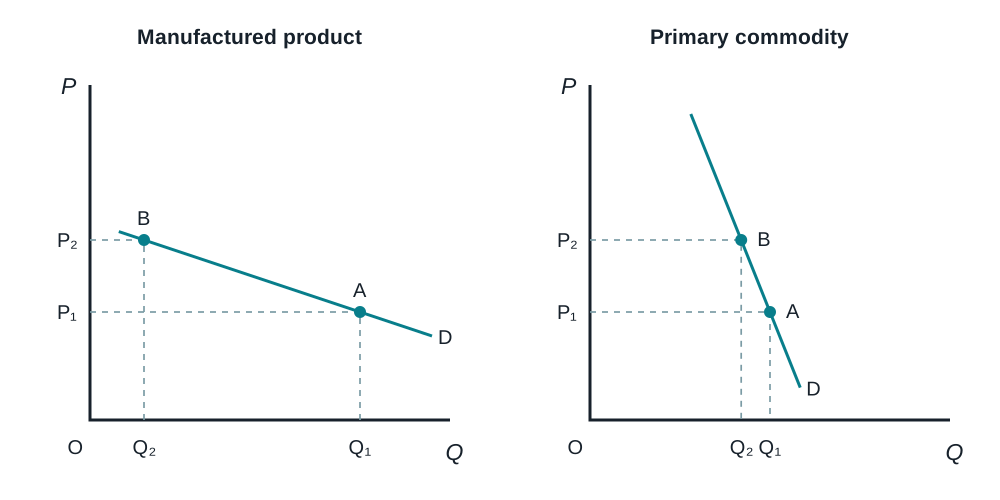
In the left panel, the manufactured product has relatively elastic demand. The price rise (P1 to P2) causes a movement along the flatter demand curve from A to B, and quantity demanded falls by a proportionately larger amount, from Q₁ to Q₂. In the right panel, the primary commodity has relatively inelastic demand. The same price rise causes a movement along the steeper demand curve from A to B, but quantity demanded falls only slightly, from Q₁ to Q₂. The percentage fall in quantity demanded is smaller than the percentage rise in price, so PED < 1.
The difference in PED between primary commodities and manufactured products can be explained by the determinants of PED. The three main reasons are that many primary commodities are necessities and that they have few close substitutes, while manufactured products are more often non-essential and usually have many substitutes. Additionally, The proportion of income spent on it, add to this difference.
Degree of necessity: Necessities are goods that people consider essential; they cannot easily survive without them. The more necessary a good, the less elastic its demand. Many primary commodities are necessities. Food commodities such as wheat and rice are needed for survival, and crude oil is the raw material for the fuel that households need to heat their homes and travel to work. When the price of a necessity rises, consumers cannot easily cut back on it, so they continue to buy close to the same quantity and accept the higher price. Quantity demanded therefore falls by a less than proportionate amount, and demand is price inelastic. By contrast, many manufactured products, such as a new television or a games console, are not essential. When their price rises, consumers can choose not to buy them, or to defer their purchase, so quantity demanded falls by a more than proportionate amount, and demand is price elastic.
Number and closeness of substitutes: The more substitutes a good has, and the closer they are, the more elastic its demand. If the price of a good with many close substitutes rises while the prices of the substitutes stay the same, consumers switch to the substitutes, so quantity demanded falls by a large amount. Many primary commodities have no close substitutes for their main use. In the short run, there is no good substitute for crude oil as a source of transport fuel, and no substitute for food as a whole. When their price rises, consumers have little to switch to, so quantity demanded falls by a less than proportionate amount. Manufactured products, by contrast, usually have many close substitutes, because many firms produce competing brands and models. If the price of one brand of smartphone or car rises while other brands' prices stay the same, many consumers switch to a rival brand that meets the same need. Quantity demanded of that brand therefore falls by a more than proportionate amount and the good is elastic.
Proportion of income spent: Finally, the larger the proportion of income spent on a good, the more elastic its demand. Many manufactured products, especially durable goods such as cars and computers, take up a large proportion of a household's income, so a price rise is very noticeable and consumers respond strongly to it. Many primary commodities, by contrast, make up a small proportion of the price of the final products they are used in. For example, the price of the raw wheat in a loaf of bread is a small part of the bread's price, so a rise in the price of wheat has only a small effect on what consumers pay, and the quantity of wheat demanded falls only slightly.