
Price elasticity of supply (PES) is defined as a measure of the responsiveness of the quantity supplied of a good or service when there is a change in its price. It is calculated as PES = (% change in Qs) ÷ (% change in P). Primary commodities are "raw materials that are produced in the primary sector". This means goods that are extracted or harvested directly from natural resources, including agricultural products such as wheat and vegetables, and the products of extractive industries such as oil, natural gas and minerals. Manufactured products are "goods that have been processed by workers". They are produced by labour working with capital and raw materials, such as cars, computers and clothing.
Supply is price elastic when PES is greater than 1: a change in price causes a more than proportionate change in quantity supplied. Supply is price inelastic when PES is less than 1: a change in price causes a less than proportionate change in quantity supplied. The supply of primary commodities tends to be price inelastic, while the supply of manufactured products tends to be more price elastic.
In Figure 1 shows the PES for manufactured products and primary commodities.
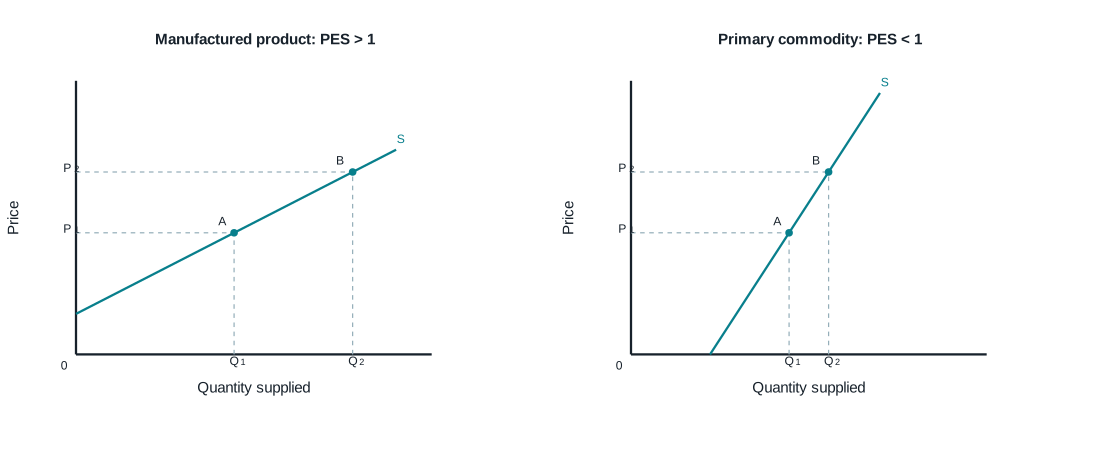
In the left panel of Figure 1, as price increases from P1 to P2, quantity supplied increases by a more than proportionate amount, from Q1 to Q2. This means the percentage rise in the quantity of the manufactured product supplied is greater than the percentage rise in price, so a higher PES and supply is price elastic. In the right panel as price increases from P1 to P2, quantity supplied increases by a less than proportionate amount from Q1 to Q2. Thus, the percentage rise in the quantity of the primary commodity supplied is smaller than the percentage rise in price, so PES < 1 and supply is price inelastic.
The difference in PES between primary commodities and manufactured products can be explained by the determinants of PES. Firstly is the length of time producers need to change their output, which is much longer for primary commodities. Secondly is the differences in the mobility of factors of production, differeces in spare capacity, and differences in the ability to store stocks.
Time: The longer it takes firms to adjust their inputs and output in response to a price change, the less elastic supply is. For primary commodities, this time is long. In agriculture, a farmer who sees a rise in the price of wheat cannot increase the quantity supplied immediately, because crops take time to grow. The farmer must wait at least until the next planting season, and then until the harvest, before more wheat can be supplied. Increasing output further is also slow, because in most areas there is only a limited amount of new land that can be brought into cultivation. Raising output per unit of land requires new technology, such as more productive seeds or better irrigation systems, which takes a great deal of time to develop and introduce. For oil, natural gas and minerals, increasing supply requires new wells or mines to be explored, built and brought into production, which needs large investment and takes years. Because this investment is so costly, firms often wait until there is a serious shortage before they act. In each case, quantity supplied can respond only slightly to a price rise in the short run, so supply is price inelastic. By contrast, many manufactured products can be produced within days or weeks. If the price of a manufactured good such as a T-shirt rises, a firm can quickly order more materials and increase production, so quantity supplied rises by a more than proportionate amount, and supply is price elastic.
Mobility of resources: The more easily and quickly resources can be moved into the production of a good, the more elastic its supply. Many of the resources used to produce primary commodities are specific to them and cannot easily be moved. Land suitable for growing a particular crop, or a deposit of oil or copper, is fixed in its location and quantity, so when the price of the commodity rises, producers cannot quickly bring more of these resources into production. In addition, primary producers often have little spare capacity: a farmer's land is usually already fully planted, and an oil field is usually already producing as much as its wells allow. Quantity supplied therefore cannot rise much in response to a higher price, so supply is inelastic. Manufacturing, by contrast, often uses labour and capital that can be moved between products more easily. Many manufacturing firms also have spare capacity, such as factories or machines that are idle for part of the day. When the price of a manufactured product rises, the firm can respond quickly, for example by adding an extra shift of workers or switching machines from making another product. Quantity supplied can rise by a more than proportionate amount, so supply is price elastic.
Storage ability: Firms that can store stocks of their output tend to have a more elastic supply, because they can respond to a price rise by selling from their stocks rather than having to produce more. Most manufactured products, such as clothing or electronics, can be kept in warehouses for long periods. If their price rises, firms can release stocks onto the market immediately, so quantity supplied rises quickly. Many agricultural commodities, such as fresh vegetables, fruit and fish, are perishable and cannot be stored for long, so producers cannot build up stocks to release when the price rises. Quantity supplied is then limited to what has just been harvested or caught, so supply is inelastic. This reason applies mainly to perishable commodities. Some primary commodities, such as grain, oil and metals, can be stored, which makes their supply somewhat more elastic than that of perishable goods.