
Income elasticity of demand (YED) is defined as a measure of the responsiveness of the demand for a good or service to a change in income. It is calculated as YED = (% change in Qd) ÷ (% change in income). Disposable income is the income available for an individual to spend or save after direct taxes and including transfer payments. Changes in real disposable income affect consumer demand, ceteris paribus. When incomes are rising, an understanding of YED helps firms predict which markets will grow fastest, so they can decide where to invest and expand production to increase their revenue. For the government, YED helps explain why the structure of the economy changes as incomes rise, with the primary sector tending to shrink as a share of GDP and the services sector growing in relative importance, so it can plan for the effects on employment, regions and trade. This essay argues that YED is important for both, but its usefulness depends on the country's stage of development, on the fact that YED values change over time, and on how fast incomes grow in different economies.
YED tells us how demand for a good changes when incomes rise. If YED > 1, demand is income elastic: a rise in income causes a more than proportionate rise in demand. Luxury goods and many services, such as foreign travel, restaurant meals and private healthcare, are income elastic. If YED is positive but less than 1, demand is income inelastic: a rise in income causes a less than proportionate rise in demand. Necessities such as food and clothing are income inelastic. If YED is negative, the good is inferior: demand falls as income rises, because consumers switch to better-quality alternatives.
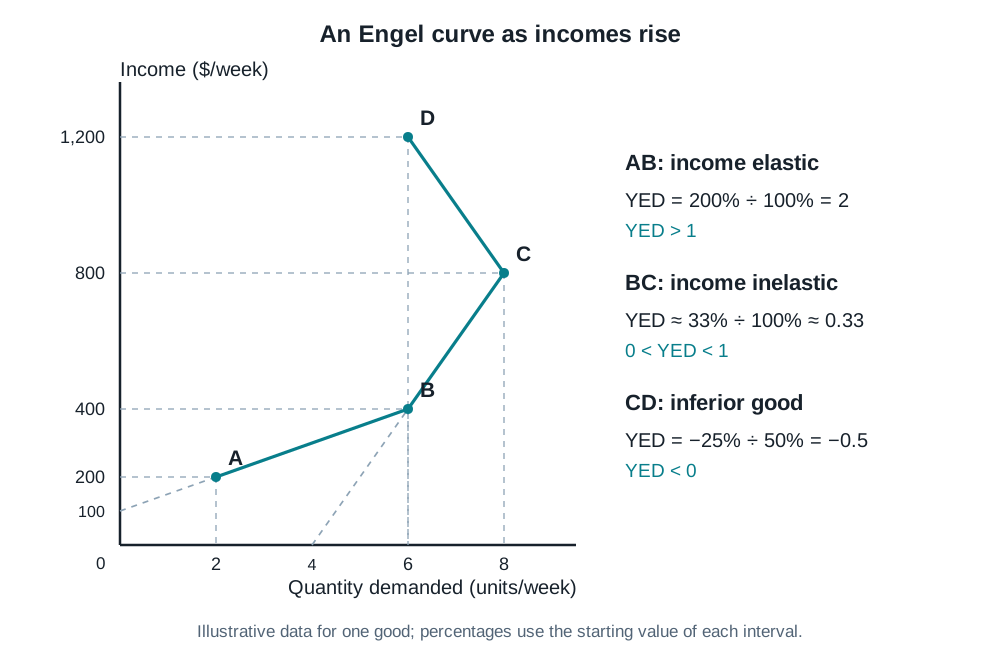
As income rises from $200 to $400 in Figure 1 (a 100% rise), quantity demanded rises from 2 to 6 units (a 200% rise), so YED = 2 and demand is income elastic. As income rises from $400 to $800 (a 100% rise), quantity rises only from 6 to 8 units (a 33% rise), so YED ≈ 0.33 and demand is income inelastic. As income rises further from $800 to $1 200 (a 50% rise), quantity falls from 8 to 6 units (a 25% fall), so YED = −0.5 and the good is considered an inferior good. The figure shows that the same good can be a luxury at low incomes, a necessity at middle incomes and an inferior good at high incomes. Real-world estimates support these categories. The YED for food in developed countries is only about 0.15 to 0.2, so a 10% rise in real income increases quantity demanded of food by only about 1.5% to 2%, other things being equal. Spending on services such as foreign travel and eating in restaurants, by contrast, grows faster than income.
Importance of YED for firms: An understanding of YED helps firms predict how their revenue will change as incomes rise. As incomes rise, the demand curve for a normal good shifts to the right. At each price, consumers buy more, so the firm can sell a larger quantity, and often at a higher price, which increases its total revenue. The size of the shift depends on YED. If its customers' real incomes grow by 3% a year, demand for a good with a YED of 2 grows by about 6% a year, while demand for a good with a YED of 0.2 grows by only about 0.6% a year, other factors being equal. At an unchanged price, a firm producing income-elastic goods can therefore expect its revenue to grow faster than its customers' incomes. A firm producing income-inelastic goods can expect slower revenue growth. A firm producing inferior goods can expect its revenue to fall at an unchanged price. These forecasts concern consumer income growth, which need not equal GDP growth. Knowing YED helps firms decide which markets to enter, where to build new capacity and how to divide their investment between products. A firm selling mainly necessities, for example, might diversify into income-elastic products to share in the growth of demand.
The expansion of luxury and coffee brands into China illustrates this. As Chinese household incomes rose rapidly after 2000, markets for luxury goods and café services expanded. This is consistent with positive YED, although income was not the only influence on demand. By 2019, Chinese consumers accounted for roughly a third of global spending on personal luxury goods, and firms such as LVMH opened many stores in Chinese cities to meet this demand. Starbucks, which opened its first store in mainland China in 1999, had more than 6000 stores there by 2023. Coffee drunk in a café is a high-YED service for many Chinese consumers. By contrast, instant-noodle consumption in China and Hong Kong fell from about 46.2 billion servings in 2013 to about 38.5 billion in 2016, according to World Instant Noodles Association estimates. This is consistent with instant noodles being inferior for some consumers, but the aggregate decline alone does not prove negative YED, because tastes, prices and alternatives also changed. Firms that understood these differences in YED could move their resources towards the markets that were growing and away from those that were shrinking.
Importance of YED for governments: An understanding of YED also helps the government explain how the structure of the economy changes as incomes rise. Every economy has three sectors. The primary sector "extracts or harvests products directly from the earth in order to produce raw materials or food". The secondary sector processes raw materials into goods and includes manufacturing, such as cars and computers, as well as construction. The services (tertiary) sector provides services such as banking, education, healthcare and tourism. Many agricultural products, especially staple foods, are income inelastic. As incomes rise, demand for agricultural output grows more slowly than income, so the primary sector's share of total output falls. Many manufactured goods are income elastic, so the manufacturing sector's share at first grows. Many services have even higher YEDs, so as incomes continue to rise, the services sector expands at the expense of both agriculture and manufacturing.
This shift in demand causes a reallocation of resources. As demand for services grows faster than demand for primary products, prices and profits may initially rise in the services sector, attracting labour and capital away from agriculture and manufacturing. The outcome also depends on productivity, supply conditions, trade and government policy.
China's economy shows this reallocation clearly. The primary sector's share of China's GDP fell from about 30% in 1980 to about 7% in 2019. The services sector overtook industry as the largest sector in 2012–13 and accounted for more than half of GDP by 2019.
Knowing this helps the government plan its policies. Workers who lose their jobs in declining industries, such as farming, may not have the skills needed in growing industries, so they may become structurally unemployed. The government can reduce this by spending on education and retraining, and by investing in the infrastructure that growing industries need, such as transport and telecommunications. Because food has a low YED, farmers' incomes tend to grow more slowly than incomes in the rest of the economy. This helps explain why many governments support farm incomes and encourage workers to move into other sectors. Countries that depend on exporting primary commodities face a similar problem. As world incomes rise, demand for their exports grows only slowly. A World Bank forecast states that growth in global demand for agricultural commodities such as rice and wheat would slow from an average of 2.8% a year in 2010–16 to 1.8% a year in 2017–18, as consumers with rising incomes switch to foods with more protein and fat. A government that understands this has a strong reason to diversify its economy into manufacturing and services.
However, there are several factors that limit the usefulness of YED.
Firstly, the importance of YED for both firms and the government depends on a country's stage of development. YED values differ widely between rich and poor countries. YED for food is about 0.8 in poor countries but only 0.15 to 0.2 in rich countries. A 10% rise in real income therefore increases quantity demanded of food by about 8% in a poor country, but by only about 1.5% to 2% in a rich one, other things being equal. Similarly, goods such as Coca-Cola and coffee are luxuries for many consumers in less developed countries, but necessities in developed countries. A firm that applies a YED estimate from a rich country to a poor one would therefore make the wrong prediction. A food producer, for example, might expect slow growth in a market where demand is in fact growing almost as fast as incomes. For governments, the sectoral pattern described above is most useful in middle-income economies that are going through rapid structural change, such as China. In low-income economies, rising incomes may increase demand for food quite strongly at first, so the primary sector may decline only slowly. In high-income economies, most of the shift towards services has already happened.
A second limitation is that YED values are not fixed. As incomes rise, goods that were once luxuries become necessities, and their YED falls, as the move from section AB to section BC in Figure 1 shows. Mobile phones and air conditioners were luxuries in many countries a few decades ago but are now treated as necessities. A firm that bases its investment plans on a past estimate of YED may therefore overestimate future growth in demand. This is particularly risky for products whose YED falls as more households own them. Firms therefore need to update their estimates regularly and look at the income level of their target consumers, not just at a single YED value. For the government, YED estimates are also uncertain, because they are calculated from past data in which incomes, prices, tastes and technology were all changing at the same time. Separating the effect of income alone is difficult, so forecasts of sectoral change are only approximate.
Finally, the importance of YED depends on how fast incomes are growing. When incomes grow slowly, as in many developed economies, the differences between high-YED and low-YED goods produce only small differences in the growth of demand. When incomes grow quickly, as in many emerging economies, the same differences in YED produce very large differences in growth between markets. This is why firms such as LVMH and Starbucks have concentrated their expansion in fast-growing economies such as China, rather than in slow-growing ones. For governments, differences in growth rates between countries also matter for trade. If incomes in the countries that buy a primary-exporting country's commodities rise slowly, and those commodities have low YEDs, demand for its exports will grow very slowly, while its demand for imported manufactured goods and services may grow quickly if its own real incomes rise and those imports have high YED. This can put pressure on its balance of trade. Income growth is also not guaranteed. In a recession, incomes fall, and, other things being equal, high-YED goods and services suffer larger percentage falls in demand than income-inelastic normal goods, so firms that have expanded into income-elastic markets are also exposed to greater risk.
In conclusion, when incomes are rising, an understanding of YED is important for both firms and the government. For firms, it helps predict which markets will grow fastest. The growth of luxury goods and coffee shops in China, and the decline of instant noodles, are consistent with the differences in YED discussed above, although those trends do not isolate the effect of income. This helps them direct investment towards products with high YEDs. For the government, it explains one reason why resources tend to move from the primary sector to manufacturing and especially services as incomes rise, as China's experience shows. This allows the government to prepare for structural unemployment, regional decline and slower growth in primary exports. However, YED is a guide rather than a precise forecast. Its values differ between developed and less developed economies, they change over time as luxuries become necessities, and their impact depends on how fast incomes grow. On balance, YED is most important for firms and governments in fast-growing, middle-income economies undergoing rapid structural change, provided its estimates are regularly updated and applied to the right income level.