
Paragraph 1: Definitions and assumptions
A monopoly is "a market structure where there is only one firm in the industry, so the firm is the industry." In this context, the short run is the period during which at least one of the firm's inputs, such as its factory or heavy machinery, is fixed and cannot be changed. The long run is the period over which all inputs can be changed, so the firm can change its scale of production, and in a competitive industry, new firms would have time to enter. Abnormal profit is profit above normal profit, earned when total revenue is greater than total cost, including the opportunity cost of the owners' resources (P > AC).
The model of monopoly rests on the following assumptions:
- There is a single firm in the industry, so the firm is the industry.
- The firm produces a unique good with no close substitutes.
- There are high barriers to entry, which prevent other firms from entering the industry.
- The firm aims to maximise profit.
These assumptions give the monopoly its characteristics. Because the firm is the whole industry and its product has no close substitutes, it faces the downward-sloping market demand curve, so it is a price maker with significant market power: it can choose the price at which it sells. Because it maximises profit using this market power, it can earn abnormal profit in the short run. Because barriers to entry keep out competitors, it can continue to earn abnormal profit in the long run.
Paragraph 2: Abnormal profit in the short run
Figure 1 shows a monopolist, with price, cost and revenue on the vertical axis and quantity on the horizontal axis. It shows a downward-sloping demand curve labelled D = AR, a steeper marginal revenue curve, MR, lying below it, a U-shaped marginal cost curve, MC, and a U-shaped average cost curve, AC, with MC passing through the minimum point of AC. MR crosses MC at point E, giving the profit-maximising output Qm. A vertical line from Qm meets the demand curve at price Pm and the AC curve at ACm, which is below Pm. The rectangle with height Pm − ACm and width Qm is shaded and labelled "abnormal profit".
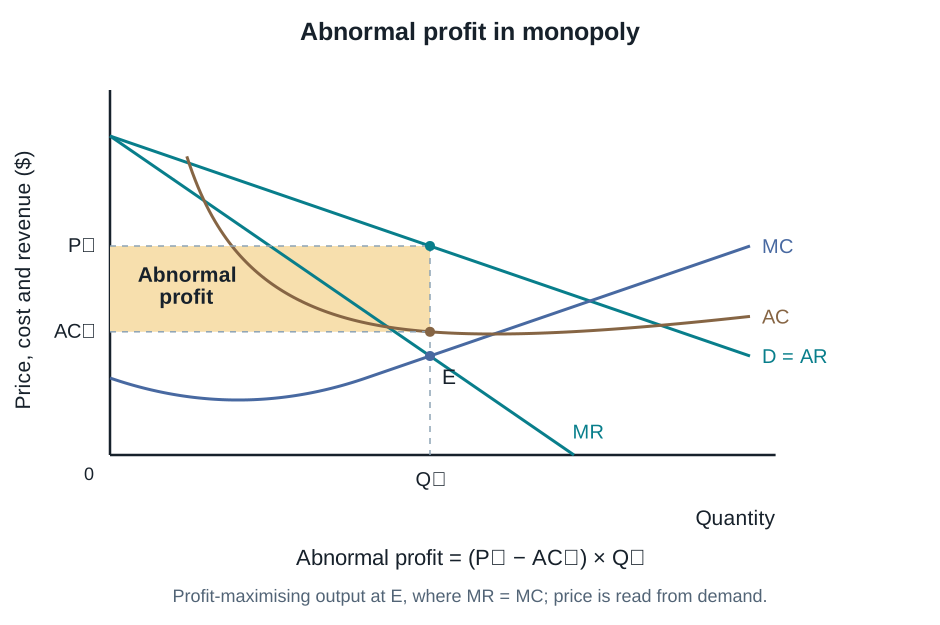
The shapes of the curves in Figure 1 follow from the assumptions. The most important is the downward-sloping demand curve. Since the monopolist is the only seller, it faces the market demand curve, so it has market power. It can raise its price, but only by accepting a lower quantity sold, and it can sell more only by lowering its price. Price equals average revenue, so the demand curve is also the AR curve. The MR curve lies below AR because, to sell one more unit, the monopolist must lower the price not only on that unit but on all the units it sells. The extra revenue from the last unit is therefore its price minus the revenue lost on all the other units. The MC and AC curves are U-shaped because, in the short run, with some inputs fixed, the firm first experiences increasing and then diminishing marginal returns as it adds more variable inputs.
The monopolist maximises profit by producing where MR = MC, at Qm. At any output below Qm, MR > MC, so producing one more unit adds more to revenue than to cost, and profit rises. The firm therefore increases output. At any output above Qm, MC > MR, so the last unit adds more to cost than to revenue, and profit falls. The firm therefore reduces output. Profit is greatest only at Qm. Having chosen Qm, the monopolist charges the highest price consumers are willing to pay for that quantity, which is read from the demand curve, at Pm. At Qm, average cost is ACm. Because Pm > ACm, the firm earns abnormal profit of (Pm − ACm) on each unit. Its total abnormal profit is (Pm − ACm) × Qm, shown by the shaded rectangle. A monopoly does not always earn abnormal profit. If demand were low or costs high, so that the AC curve lay above the demand curve at Qm, it would make a loss. If AC equalled price at Qm, it would earn only normal profit. Its market power, however, allows it to set price above average cost wherever demand is strong enough.
Paragraph 3: Why abnormal profit persists in the long run
In perfect competition, abnormal profit in the short run attracts new firms into the industry in the long run. Their entry increases market supply, which lowers the price until P = AC and only normal profit remains. In monopoly, this process cannot happen, because high barriers to entry prevent new firms from entering, even in the long run when they would otherwise have time to do so. No new firms enter, so market supply does not increase and the price is not pushed down. The monopolist can therefore keep producing where MR = MC and charging a price above average cost, so it can continue earning abnormal profit indefinitely. In the long run, the monopolist can also change all its inputs and choose the scale of production that minimises its costs for its chosen output. The long-run position follows the same logic as Figure 1, with the AC and MC curves representing long-run average cost and long-run marginal cost respectively. For this reason, the distinction between the short run and the long run is far less important in monopoly than in perfect competition.
Long-run abnormal profit depends on the barriers to entry, each of which prevents new firms from entering in a different way:
- Economies of scale. A large monopolist producing a high output has much lower average costs than a new firm entering on a small scale. It can charge a price below the entrant's average cost, so a small entrant would make a loss. Entering on a large scale would require huge start-up costs and great risk. In a natural monopoly, these economies are so large that one firm can supply the whole market at a lower average cost than two or more firms could.
- Legal barriers. Patents give a firm that has developed a new product the sole right to produce it for a set period, as with new medicines. Licences and copyrights also give exclusive rights to provide a service or sell a work. Tariffs, quotas and other trade restrictions can keep out foreign competitors. In each case, the law itself prevents rivals from supplying the same product.
- Control of essential resources. If the monopolist owns or controls the supply of a resource needed to make the product, rivals cannot produce it. De Beers' control of about 90% of the world's rough diamond supply in the 1980s gave it significant control over diamond prices.
- Branding. Successful branding builds consumer loyalty, so consumers are unwilling to switch to a new firm's product even if it is similar in quality, which makes entry unprofitable.
- Aggressive tactics. When a new firm threatens to enter, the monopolist can cut its price, advertise aggressively or threaten a takeover, which discourages entry.
Because these barriers stop new firms from increasing market supply, the monopolist's abnormal profit is not competed away. It can last as long as the barriers remain and demand stays high enough for price to exceed average cost. If a barrier is removed, for example when a patent expires and other firms can produce copies of a drug, new firms can enter, and abnormal profit falls.