
An oligopoly is a market structure dominated by a small number of large firms. It rests on the following assumptions:
- Few large firms: there is a small number of large firms, and each is aware of the presence of the others.
- Homogeneous or differentiated products: firms may sell homogeneous products, such as crude oil produced by OPEC members, or differentiated products, such as cars.
- High barriers to entry: it is difficult for new firms to enter, because of barriers such as large economies of scale, high start-up costs, strong brand loyalty, or patents and licences.
- Interdependence: because there are only a few firms, the actions of one firm, such as a change in price or output, noticeably affect the sales and profits of the others, so each firm must consider how its rivals will react before making any decision.
Interdependence is the defining characteristic of an oligopolistic firm, and the other characteristics in this essay follow from it: the incentive to collude, the possibility of abnormal profits and deadweight loss, the incentive to cheat, and the use of non-price competition.
Because firms are interdependent, the outcome of each firm's pricing decision depends on what its rivals do. This can be shown using game theory.
Figure 1 shows two firms, A and B, each choosing between a "high price" and a "low price", with A's profit listed first in each cell. If both charge a high price, each earns $100m. If A charges a low price while B charges a high price, A wins customers from B and earns $150m while B earns $40m, and the reverse is true if B cuts its price while A does not. If both charge a low price, each earns $60m.
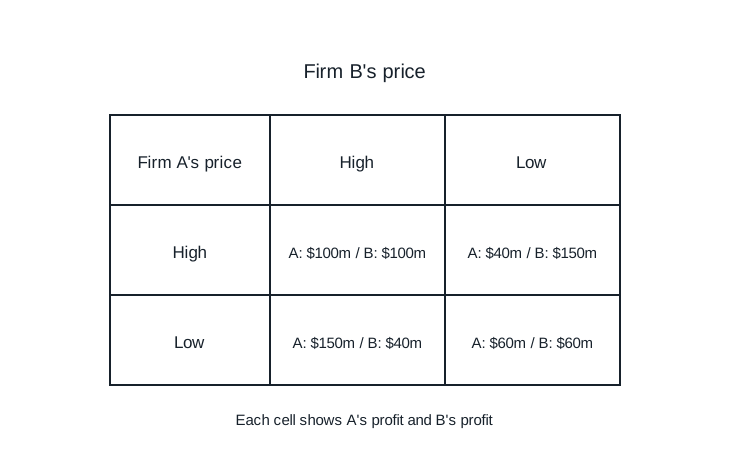
Acting alone, each firm is tempted to cut its price, because it earns more by doing so whatever its rival does ($150m rather than $100m if the rival keeps a high price, and $60m rather than $40m if the rival cuts). If both firms reason this way, they end up in the low-price/low-price cell, earning only $60m each. However, both would be better off in the high-price/high-price cell, earning $100m each. This gives oligopolistic firms an incentive to collude, which means agreeing to limit competition by fixing prices or output quotas. Collusion can be formal, as in a cartel such as OPEC, or tacit, as when firms follow a price leader.
When firms collude, they act together as if they were a single monopolist.
Figure 2 shows the industry drawn like a monopoly. It shows a downward-sloping demand curve (D = AR), an MR curve lying below it, and the MC and AC curves. The colluding firms jointly produce Qm, where MR = MC, and charge Pm, read from the demand curve. Because Pm lies above AC at Qm, the rectangle between Pm and AC, with width Qm, is shaded as abnormal profit.
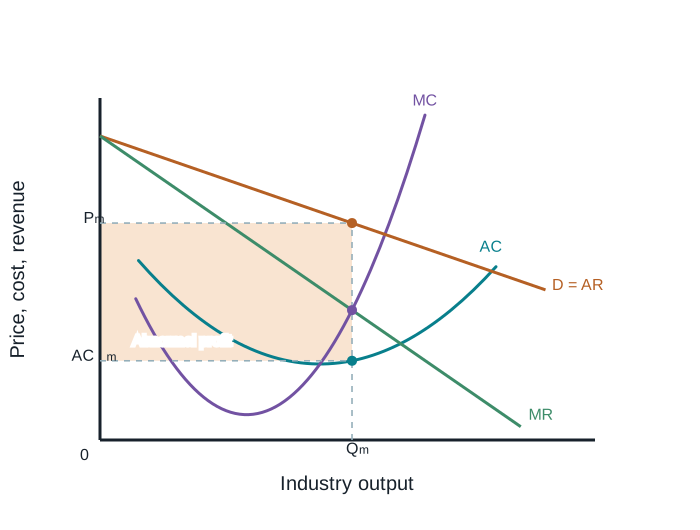
Profit is maximised where MR = MC, because at that output no change in production can increase profit. The colluding firms have price-setting power because together they control most of the industry's output. By restricting output to Qm, they can raise the price to Pm, well above average cost. Since P > AC, they earn abnormal profit. High barriers to entry prevent new firms from entering to compete this profit away, so it can last in the long run.
The output restriction made possible by market power can also cause a loss of welfare for society. At Qm, the price Pm is greater than marginal cost, so consumers value the last unit more than it costs to produce. Society would be better off if more were produced.
Figure 3 shows the socially optimal output where demand meets MC. The shaded area between demand and MC, from collusive output to the socially optimal output, is deadweight loss.
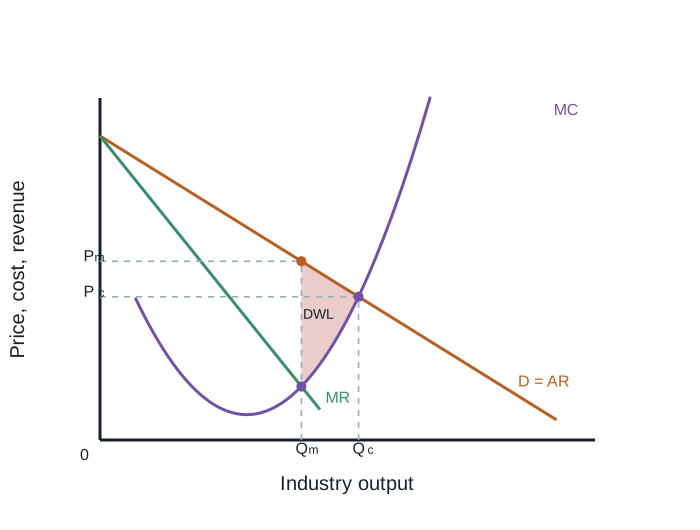
A collusive oligopoly therefore underproduces and overcharges compared with the socially optimal level, and it is allocatively inefficient.
Interdependence also gives each firm an incentive to cheat on a collusive agreement. Going back to Figure 1, if firm B keeps to the agreed high price, firm A can earn $150m instead of $100m by secretly cutting its price or producing above its quota. Firm B faces the same temptation. In this payoff matrix, cheating is therefore each firm's dominant strategy. However, once one firm cheats, the other is likely to retaliate and both end up at $60m each. This is a prisoner's dilemma, and it is why collusive agreements tend to be unstable. For example, an OPEC member may have an incentive to produce above its agreed quota.
Because firms are interdependent, a price cut by one firm is likely to be matched by its rivals, which can lead to a price war that lowers profits for all firms. Non-collusive oligopolistic firms therefore tend to keep prices stable and compete through non-price competition instead, such as branding, advertising and product development. Non-price competition can increase demand for a firm's product and build brand loyalty without triggering retaliation on price.
An oligopolistic firm is one of a small number of large, interdependent firms in a market with high barriers to entry, selling either homogeneous or differentiated products. Interdependence gives firms an incentive to collude and act like a monopolist, which can let them earn abnormal profits but creates deadweight loss in the case shown. It also gives each firm an incentive to cheat on any agreement, and the fear of price wars leads firms to rely on non-price competition.