
An oligopoly is a market structure dominated by a small number of large firms. It rests on several assumptions:
- There is a small number of large firms, each aware of the others.
- Products may be homogeneous, such as oil, or differentiated, such as cars.
- There are high barriers to entry, such as economies of scale, high start-up costs and brand loyalty.
- Firms are interdependent, so each firm's decisions affect its rivals and each must consider how its rivals will react.
Collusion is an agreement between firms to limit competition, for example by fixing prices, setting output quotas or dividing up the market. It can be formal, as in a cartel such as OPEC, or tacit, as when firms follow a price leader without an explicit agreement. Cheating happens when a firm in a collusive agreement secretly breaks it, by charging a lower price or producing more than its agreed quota.
Because firms are interdependent, each firm's profit depends on its rivals' decisions as well as its own. If firms compete, a price cut by one is likely to be matched by the others, which can lead to a price war that leaves all firms with lower prices and lower profits. By colluding, firms reduce this uncertainty and can act together as a single monopolist to maximise their joint profit.
Figure 1 shows the industry under collusion, drawn like a monopoly. It shows the downward-sloping market demand curve (D = AR), an MR curve below it, and the MC and AC curves. The colluding firms jointly produce Qm, where MR = MC, and charge Pm, read from the demand curve. Because Pm lies above AC at Qm, the rectangle between Pm and AC, with width Qm, is shaded as the joint abnormal profit. Total output Qm is then shared among the member firms as quotas.
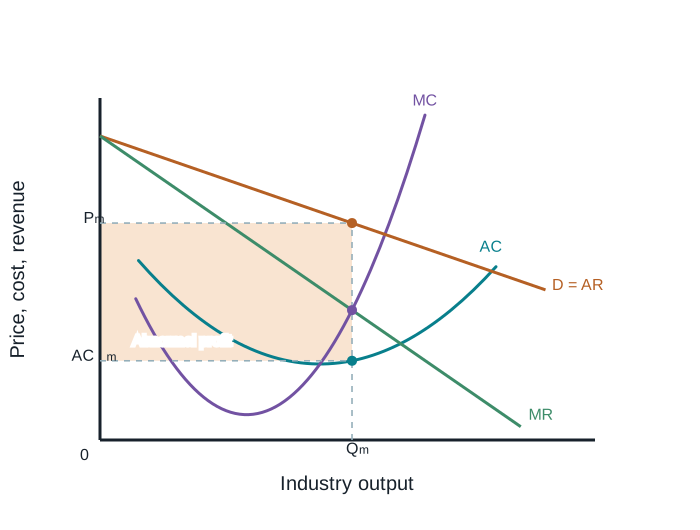
By restricting industry output to Qm, where MR = MC, the colluding firms can charge a price Pm above average cost, so they earn abnormal profit (P > AC). This is the highest total profit the industry can earn. High barriers to entry prevent new firms from entering and competing it away, so it can last in the long run.
Colluding to earn these abnormal profits benefits the firms in several ways:
- Higher profit: each member earns more than it would by competing.
- Stability: profits are more stable and predictable, because the risk of a price war is reduced.
- Investment: the extra profit can be used to fund investment, research and development, or payments to shareholders.
This is why oligopolistic firms have an incentive to collude.
Although collusion maximises the joint profit of the group, it does not maximise each firm's own profit. At the high collusive price, each firm can gain by secretly undercutting its rivals. This can be shown using game theory.
Figure 2 shows two firms, A and B, each choosing between a "high price" (keeping the agreement) and a "low price" (cheating), with A's profit listed first in each cell. If both keep the high price, each earns $100m. If A cuts its price while B keeps the high price, A wins customers from B and earns $150m while B earns only $40m. The reverse is true if B cuts its price while A keeps the high price. If both cut their prices, each earns $60m.
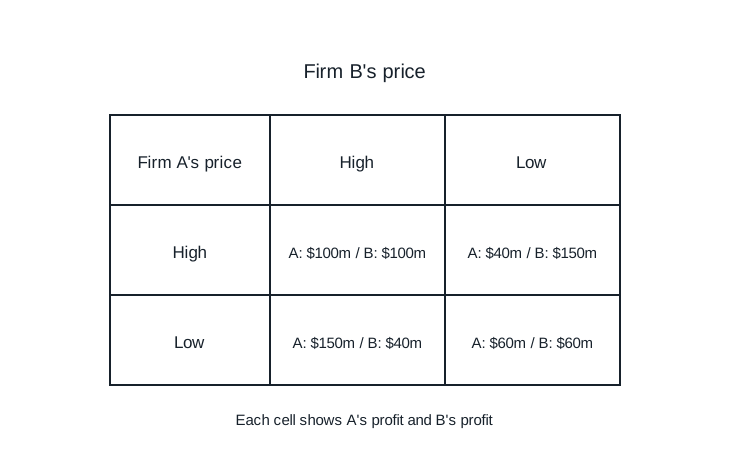
The matrix shows that if firm B sticks to the agreement, firm A can increase its profit from $100m to $150m by cheating. This is because A wins customers from B at a price that is still well above its costs. Firm B faces exactly the same temptation. However, cheating does not stay one-sided for long. Once firm B sees its sales and profit fall to $40m, it will follow and cut its own price, because $60m is better than $40m. Both firms then end up in the low-price/low-price cell, earning only $60m each.
Whatever the rival does, each firm earns more by cutting its price, so cheating is each firm's dominant strategy. The result is a prisoner's dilemma: each firm acting in its own interest leaves both worse off than if they had both kept to the agreement. This explains why collusive agreements are often unstable. For example, an OPEC member may have an incentive to produce above its agreed quota.
Because firms know that a price cut is likely to be matched and could lead to a price war, oligopolistic firms often avoid competing on price altogether. Instead, they engage in non-price competition, such as advertising, branding and product development. This allows them to win customers and increase demand without triggering retaliation on price.
Oligopolistic firms are interdependent, which gives them an incentive to collude: by acting together as a monopolist, they can restrict output, raise price and maximise their joint profit, which is abnormal in the case shown while avoiding price wars. However, interdependence also gives each firm an incentive to cheat, because it can earn even higher profit by undercutting its rivals. Since rivals will follow, cheating leads to lower profits for all, which makes collusion unstable and encourages firms to compete through non-price means instead.