
An oligopoly is a market structure dominated by a small number of large firms. It rests on several assumptions:
- There is a small number of large firms, each aware of the others.
- Products may be homogeneous, such as oil, or differentiated, such as cars.
- There are high barriers to entry, such as economies of scale, high start-up costs and brand loyalty.
- Firms are interdependent.
Interdependence means that, because there are only a few firms, the actions of one firm, such as a change in price, noticeably affect the sales and profits of its rivals. Each firm must therefore consider how its rivals will react before making a decision. Non-price competition is when firms compete for customers by means other than price, such as developing new products, product differentiation, advertising and branding.
Because oligopolistic firms are interdependent, a price cut by one firm takes a noticeable share of sales from its rivals, so the rivals are likely to respond by cutting their own prices. This can lead to a price war, in which firms repeatedly undercut one another, prices fall, and every firm ends up with lower profits. This can be shown using game theory.
Figure 1 shows two firms, A and B, each choosing between a "high price" and a "low price", with A's profit listed first in each cell. If both keep a high price, each earns $100m. If A cuts its price while B keeps a high price, A takes customers from B and earns $150m while B earns $40m. The reverse is true if B cuts its price while A keeps a high price. If both cut their prices, each earns $60m.
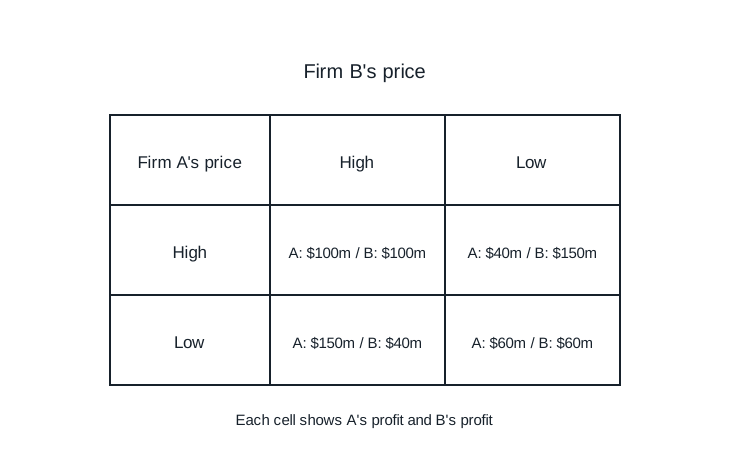
The matrix shows why price competition is tempting but self-defeating. If firm A cuts its price, it can raise its profit from $100m to $150m, but only as long as firm B does not respond. Firm B, seeing its profit fall to $40m, will match the price cut to raise its profit back to $60m. Both firms then end up in the low-price/low-price cell, earning $60m each, which is less than the $100m each they earned when both kept prices high. Neither firm has gained market share, and both have lost profit. Since each firm expects its rivals to retaliate, cutting price is unlikely to leave it better off.
Because of this fear of price wars, oligopolistic firms tend to keep prices stable and compete with each other on the basis of non-price factors instead. Important forms of non-price competition include:
- New products and product development: for example, new models of cars or smartphones with improved features.
- Product differentiation: making a product different from rivals' products through its quality, design or after-sales service.
- Advertising: informing consumers about the product and persuading them to buy it.
- Branding: building a recognisable brand identity that consumers trust and stay loyal to.
Oligopolistic firms are well placed to compete in these ways, because any persistent abnormal profits they earn, protected by high barriers to entry, can give them the resources to fund research and development, large advertising campaigns and branding.
Non-price competition benefits the firm because product differentiation, advertising and branding increase demand for its product and build brand loyalty. If consumers come to see fewer close substitutes, demand may also become less price elastic.
Figure 2 shows a firm's original demand curve D1 and a new demand curve D2 to the right of D1. At the original price P1, the firm sells more on D2 than on D1. Alternatively, the firm can raise its price to P2 and still sell the original quantity.
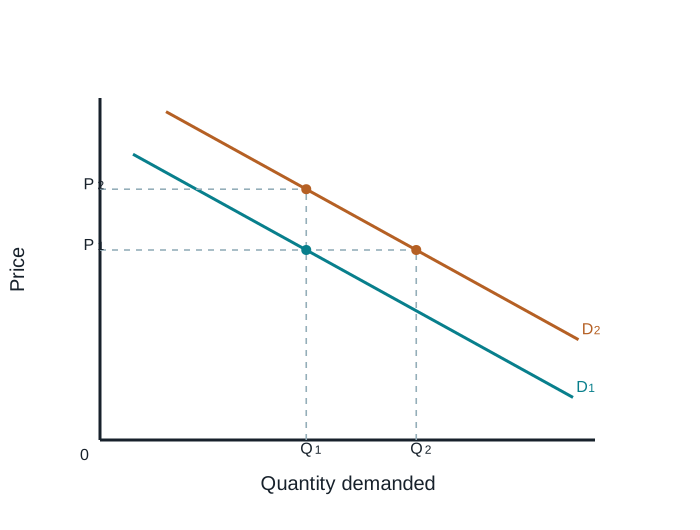
This gives the firm greater monopoly power and a greater ability to influence the price it charges, which may increase abnormal profits if extra revenue exceeds the cost of non-price competition. Unlike a price cut, a new product, an established brand or a reputation for quality cannot be copied instantly by rivals, so the advantage lasts longer. Heavy spending on advertising and research and development also raises barriers to entry, because new firms would struggle to match it.
Producers in an oligopolistic market may choose non-price competition because they are interdependent. Any price cut is likely to be matched by rivals, and game theory shows that this leads to a price war in which all firms earn lower profits. Non-price competition, such as new products, product differentiation, advertising and branding, may be funded by abnormal profits. It can increase demand and, if substitutes become less close, make it less price elastic, potentially strengthening market power and profits if the extra revenue exceeds the costs, without triggering retaliation on price.