
Perfect competition is a market structure in which a very large number of small firms sell an identical product and no single firm can influence the market price. Allocative efficiency happens when resources are allocated so that society produces the combination of goods and services it values most. For any single good, this is the output at which the marginal benefit to consumers equals the marginal cost of production (MB = MC), or equivalently where price equals marginal cost (P = MC). The model of perfect competition rests on several assumptions:
- There is a large number of small firms, each producing a tiny share of industry output and acting independently.
- There is freedom of entry and exit, with no barriers to entry.
- Firms sell homogeneous (identical) products.
- Buyers and sellers have perfect information about prices and technology.
- Factors of production are perfectly mobile.
Together, these assumptions mean that the profit-maximising behaviour of each firm leads it to produce exactly where P = MC.
In perfect competition, each firm is a price taker because its output is too small to influence the market price. Since products are homogeneous and consumers have perfect information, if a firm charged more than the market price, consumers would switch to one of the many identical rivals and the firm would lose all its sales. The firm can sell as much as it wants at the market price, so it has no reason to charge less. Each extra unit is therefore sold at the same price, which means that price equals marginal revenue (P = MR). Average revenue also equals price, so D = AR = MR = P.
Figure 1 shows the individual firm on the left and the industry on the right. In the industry panel, market demand and supply intersect to set price P. The firm takes that price and faces a horizontal demand curve labelled D = AR = MR = P. Its MC curve crosses this line at its profit-maximising output. The figure depicts long-run equilibrium, where AC reaches its minimum at that output.
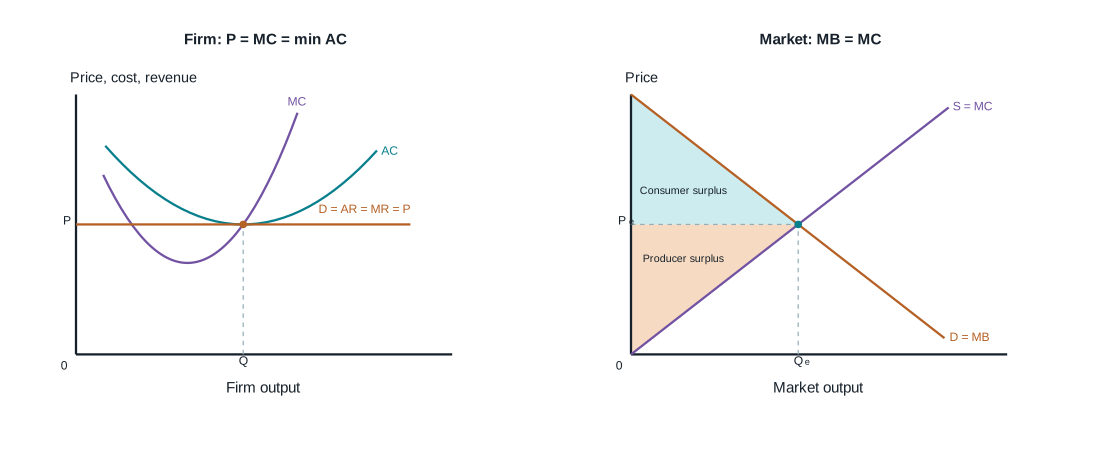
A firm maximises profit by producing up to the point where MR = MC. Before this point, the extra revenue from a unit is greater than its extra cost, so producing it adds to profit and the firm has an incentive to expand output. Beyond this point, the extra cost of a unit is greater than its extra revenue, so producing it reduces profit and the firm has an incentive to cut output. Profit is therefore maximised only where MR = MC. Since P = MR for a perfectly competitive firm, its profit-maximising output is also where P = MC. This holds whether the firm is earning abnormal profit, normal profit or a short-run loss, because the firm's demand curve is horizontal at the market price in every case.
This output is allocatively efficient because the market price represents the marginal benefit (MB) consumers receive from the last unit. Price is the amount consumers are willing to pay for that unit, and so it reflects the value they place on it. Assuming there are no externalities, the firm's marginal cost reflects the full marginal social cost of the resources used to produce the last unit. P = MC therefore implies MB = MC.
The quantity where MB = MC is the best one for society. At a lower output, consumers would value an extra unit more than the resources needed to produce it (MB > MC), so increasing output would raise total welfare. At a higher output, an extra unit would use resources worth more than the benefit consumers get from it (MC > MB), so reducing output would raise total welfare. Only at the output where MB = MC can no change in output make society better off.
In Figure 1's industry panel, this is shown at the competitive equilibrium (Pe, Qe), where the demand curve (MB) meets the supply curve (the sum of the firms' MC curves). The area between demand and Pe is shaded as consumer surplus, and the area between Pe and supply as producer surplus. Together, these show that total surplus is maximised, with no deadweight loss.
The quantity where marginal benefit equals marginal cost therefore maximises the combined consumer and producer surplus. Perfectly competitive firms reach this outcome without intending to, simply by pursuing their own profit.
Allocative efficiency is achieved in perfect competition because the model's assumptions make each firm a price taker, so P = MR. Profit maximisation at MR = MC then means P = MC. Price reflects consumers' marginal benefit and, with no externalities, MC reflects marginal social cost, so the firm produces where MB = MC and society's total surplus is maximised. This holds in both the short run and the long run.