
Perfect competition is a market structure in which a very large number of small firms sell an identical product and no single firm can influence the market price. The model rests on several assumptions. First, there is a large number of small firms, each producing a tiny share of total industry output and acting independently of the others. Second, there is freedom of entry and exit, meaning there are no barriers to entry such as high start-up costs, patents or legal restrictions. Third, firms sell homogeneous (identical) products, so consumers see no difference between one firm's output and another's. Fourth, there is perfect information: buyers and sellers know all prices, and have relevant market information. Finally, there is perfect resource mobility, so factors of production can move freely into and out of the industry. These assumptions give firms in perfect competition three key characteristics: they are price takers, they cannot earn abnormal profits in the long run, and they are allocatively efficient when there are no externalities.
Firms in perfect competition are price takers because they have to accept the price set by the market. Each firm is very small compared with the industry as a whole, so changes in its own output have no noticeable effect on market supply and therefore none on the market price. Because products are homogeneous and consumers have perfect information, if a firm raised its price even slightly above the market price, consumers would switch to any of the many identical rivals and the firm would lose all its sales. There is also no reason for a firm to charge below the market price, since it can already sell as much as it wants at the going price.
Figure 1 shows two side-by-side panels. On the left, the industry diagram has a downward-sloping market demand curve and an upward-sloping market supply curve, which intersect to set the equilibrium price Pe. A dotted horizontal line runs from Pe across to the right-hand panel, which shows the individual firm. There, the firm's demand curve is a horizontal (perfectly elastic) line at Pe, labelled D = AR = MR = P.
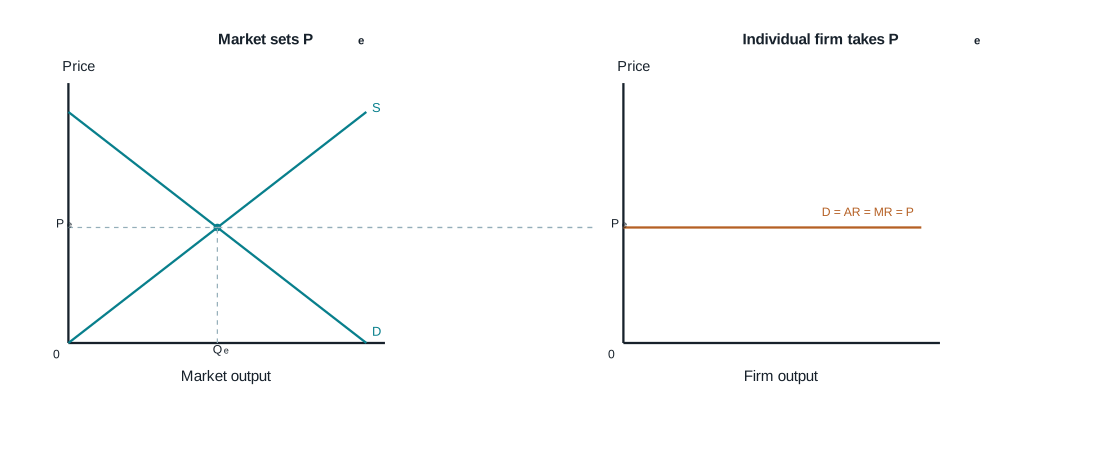
Because the firm sells every unit at the same price, each extra unit sold adds exactly P to total revenue, so marginal revenue equals price (MR = P). Average revenue, or total revenue divided by quantity, is also equal to P (AR = P). The firm's demand curve is the horizontal line at the market price, so D = AR = MR = P.
In the short run, a perfectly competitive firm may make abnormal (supernormal) profits. This can happen when market demand is high, for example because consumers have a high willingness to pay, or when the firm's costs are low relative to the market price.
Figure 2 shows the firm making abnormal profits in the short run. The firm produces where MC = MR at quantity Q1. At this output, the price line (D = AR = MR) lies above the AC curve, and the shaded rectangle between P and AC, with width Q1, represents abnormal profit.
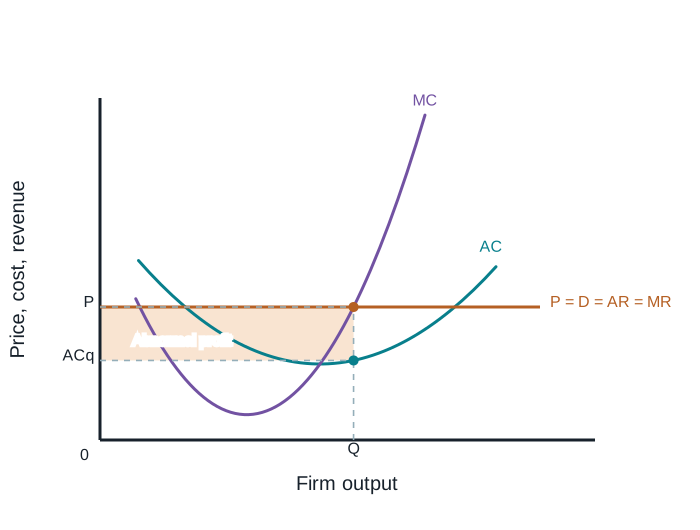
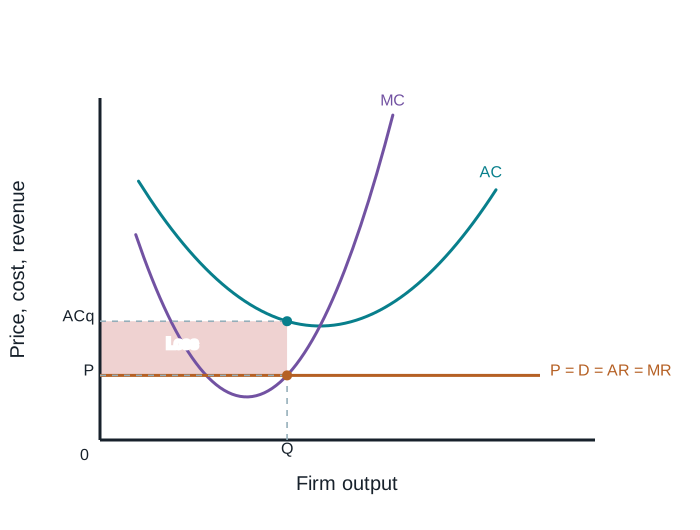
Figure 3 shows the opposite case: AC lies above the price line at the profit-maximising output, and the shaded area represents a loss.
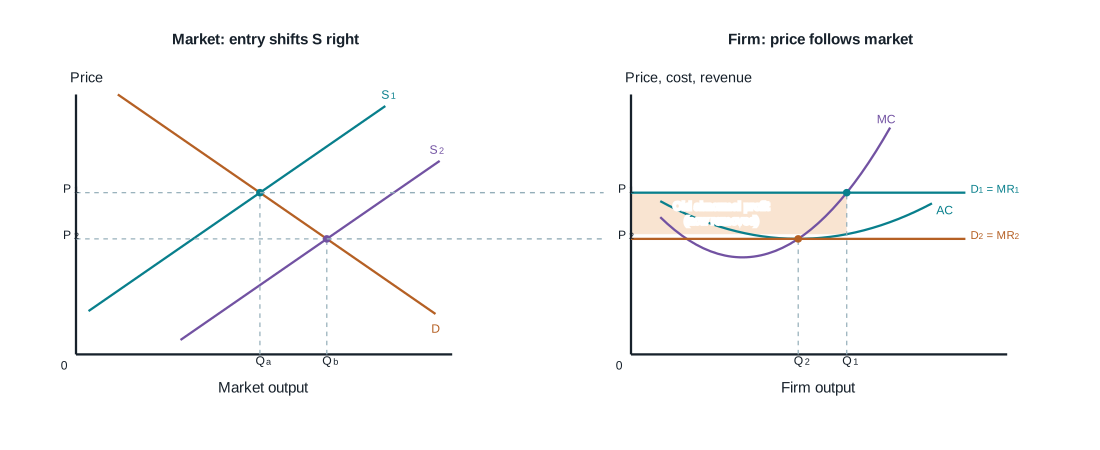
These abnormal profits cannot last in the long run. Because there is perfect information, firms outside the industry can see that abnormal profits are being made, and because there are no barriers to entry, they are able to enter the market. As new firms join, the market supply curve shifts to the right. In the industry diagram, this lowers the equilibrium price. Since each firm is a price taker, its horizontal demand curve (D = AR = MR) shifts down to the new, lower market price. Firms keep entering for as long as abnormal profits remain, so price keeps falling until the firm's demand curve is just tangent to the lowest point of the AC curve. At that point P = AC, and the firm earns only normal profit, which is just enough to keep it in the industry. Entry then stops, because there is no longer any incentive to join.
The same process works in reverse for losses. If firms are making losses, some will leave the industry, which is easy because there are no exit barriers and resources are perfectly mobile. Market supply then shifts left and the price rises until the remaining firms are back to earning normal profit. In long-run equilibrium, a perfectly competitive firm therefore always earns normal profit, producing where P = MC = MR = AC.
Figure 4 shows this long-run adjustment. In the industry panel, supply shifts from S1 to S2 and price falls from P1 to P2. In the firm panel, the demand curve shifts down from D1 = MR1 to D2 = MR2 and becomes tangent to AC at its minimum point, where MC also crosses.
Assuming no externalities, a perfectly competitive firm achieves allocative efficiency, in both the short run and the long run. Allocative efficiency happens when resources are allocated to produce the output society values most, which is the point where price, representing consumers' marginal benefit, equals marginal cost (P = MC).
All firms are assumed to maximise profit by producing where MR = MC. Marginal analysis shows why. At any output below the MR = MC point, MR is greater than MC, so producing one more unit adds more to revenue than to cost, and profit rises. The firm therefore has an incentive to expand output. At any output beyond the MR = MC point, MC is greater than MR, so the last unit adds more to cost than to revenue and profit falls. The firm therefore has an incentive to cut output. Profit is only maximised where MR = MC, because no change in output can increase it from there.
Since the perfectly competitive firm is a price taker, P = MR. Its profit-maximising condition MR = MC therefore also means P = MC. In other words, simply by pursuing its own profit, the firm produces exactly the output at which the value consumers place on the last unit equals the cost of the resources used to make it. This holds in the short run whether the firm is making abnormal profit, normal profit or a loss while it continues producing, because P = MR at every price. It also holds in the long-run equilibrium, so allocative efficiency is a defining characteristic of perfect competition.
This can be seen in Figures 2–4, where the profit-maximising output is always at the intersection of MC with the horizontal P = MR line, which means P = MC.
Firms in perfect competition have three characteristics that follow from the model's assumptions. Large numbers, small size and homogeneous products make firms price takers facing a perfectly elastic demand curve where D = AR = MR = P. Perfect information and freedom of entry and exit mean abnormal profits or losses in the short run are removed in the long run, leaving only normal profit. And because P = MR, profit maximisation at MR = MC always means P = MC, so firms are allocatively efficient when there are no externalities.