
Perfect competition is a market structure in which a very large number of small firms sell an identical product and no single firm can influence the market price. It rests on these assumptions:
- There is a large number of small, independent, price-taking firms.
- There is freedom of entry and exit, with no barriers to entry.
- Firms sell homogeneous products.
- Buyers and sellers have perfect information.
- Resources are perfectly mobile.
Abnormal (supernormal) profit is earned when price is greater than average cost (P > AC). Normal profit is earned when price equals average cost (P = AC), which is the minimum return needed to keep a firm in its current industry. The long run is the period in which all factors of production are variable, so firms can enter or leave the industry. The key to this essay is that freedom of entry and exit only operates in the long run.
In the short run, the number of firms in the industry is fixed, so a perfectly competitive firm can earn abnormal profit, normal profit or a loss. It accepts the market price and produces where MC = MR if price covers average variable cost, and whether it makes a profit depends on where price lies relative to AC at that output.
Figure 1 shows the firm's horizontal D = AR = MR line at price P lying above AC at the profit-maximising output Q, where MC = MR. The rectangle between P and AC, with width Q, is shaded as abnormal profit.
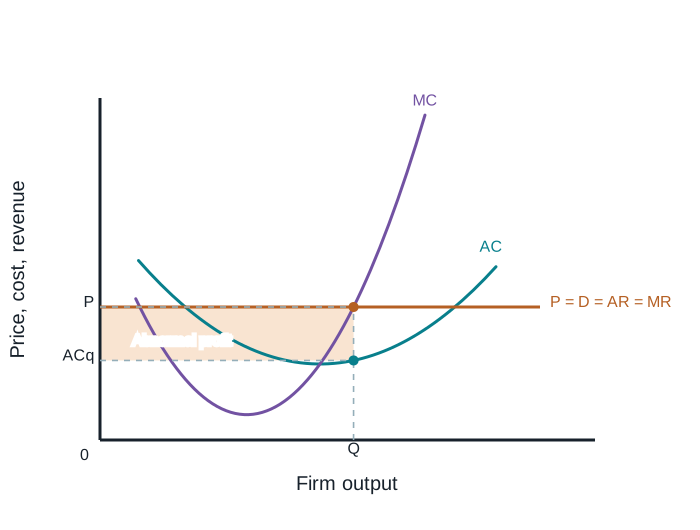
Figure 2 shows the D = AR = MR line just tangent to the minimum point of AC, which is where MC also crosses. At this output P = AC, so the firm earns only normal profit.
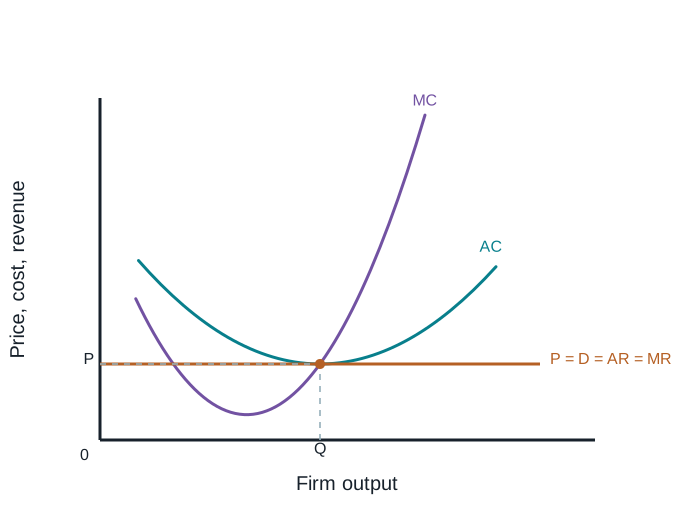
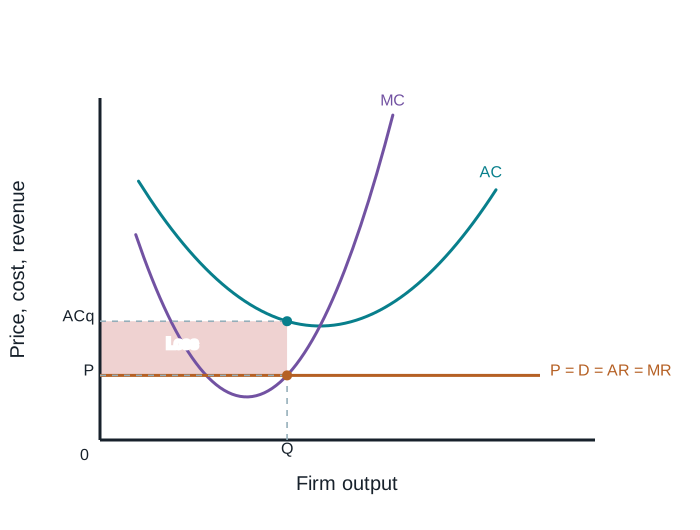
Figure 3 shows the D = AR = MR line lying below AC at the output where MC = MR. The rectangle between AC and P, with width Q, is shaded as a loss.
Which case happens in practice depends on market conditions, because the price is set by industry supply and demand rather than by the firm. If consumers' willingness to pay rises, for example because tastes shift towards the product or incomes increase for a normal good, market demand shifts right. The market price then rises above AC and firms earn abnormal profit. Abnormal profit can also arise if costs fall across the industry, for example through cheaper raw materials or a new technology that all firms adopt, so that AC falls below the resulting market price. On the other hand, a fall in demand or a rise in costs pushes price below AC and causes losses. These market conditions can affect the whole industry rather than a single firm.
In the long run, firms always earn normal profit, starting either from abnormal profit or from a loss. The first case is when firms begin by earning abnormal profit.
Figure 4 shows two side-by-side panels, with the price levels matched by dotted horizontal lines. In the market panel, demand D intersects the original supply curve S1 at price P1 and quantity Qa. In the firm panel, the firm's demand curve D1 = MR1 sits at P1, and the firm produces Q1 where MC = MR1. Because P1 lies above AC at Q1, the shaded area between P1 and AC is abnormal profit. Supply in the market panel then shifts right to S2, lowering the price to P2 and raising market quantity to Qb. In the firm panel, the demand curve falls to D2 = MR2 at P2, which is tangent to the minimum point of AC where MC crosses, and the firm's output falls to Q2.
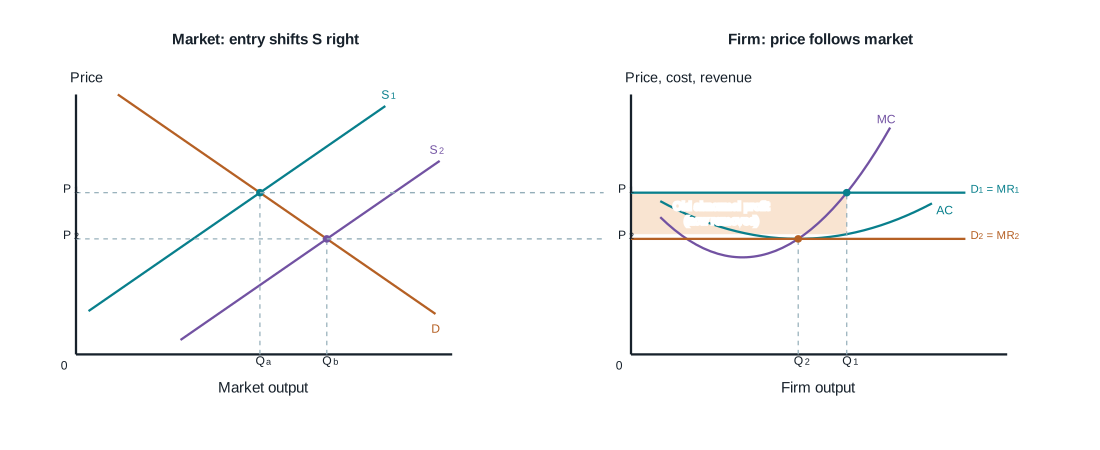
The firms in the industry initially accept the price P1 determined in the market and earn abnormal profit in the short run. Because there is perfect information, firms outside the industry can see these profits, and because there are no barriers to entry and resources are perfectly mobile, they are able to enter. As the industry moves into the long run, new firms enter and the market supply curve shifts to the right, causing the price to fall. Since each firm is a price taker, its horizontal demand curve shifts down with the market price. Entry continues as long as any abnormal profit remains. Market supply keeps increasing until the new supply curve S2 gives a price of P2, at which abnormal profit has been removed. All firms in the industry then earn normal profit where P = minimum AC, and there is no longer any incentive for new firms to enter.
The second case is when firms begin by making losses.
Figure 5 shows the same two-panel layout. In the market panel, demand D intersects the original supply curve S1 at a low price P1 and quantity Qa. In the firm panel, the demand curve D1 = MR1 at P1 lies below AC at the firm's output Q1, and the shaded area between AC and P1 is the loss. Supply in the market panel then shifts left to S2, raising the price to P2. In the firm panel, the demand curve rises to D2 = MR2 at P2, which is tangent to the minimum point of AC where MC crosses.
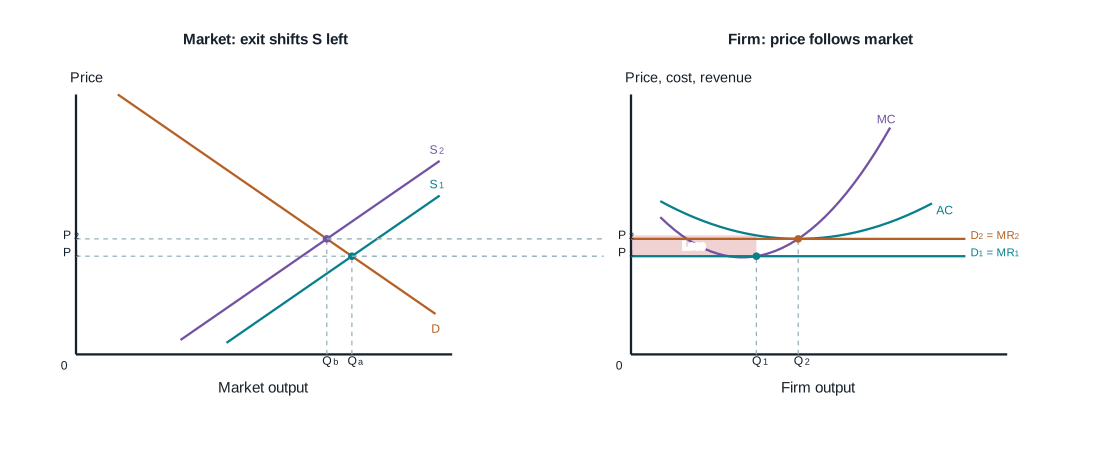
The firms in the industry initially accept the price P1 determined in the market and make losses in the short run. In the long run, there are no barriers to exit and resources are perfectly mobile, so some loss-making firms leave the industry and move their resources to more profitable uses. This shifts the market supply curve to the left and pushes the price up. Exit continues as long as firms are making losses. Market supply keeps decreasing until the new supply curve S2 gives a price of P2, at which the losses have been removed for the firms that remain. All remaining firms then earn normal profit where P = minimum AC, and there is no further incentive for firms to leave.
Firms in perfect competition do not earn abnormal profit in the long run because perfect information and freedom of entry and exit allow the number of firms to adjust. Abnormal profit attracts new firms, which increases market supply and lowers price. Losses cause firms to leave, which decreases market supply and raises price. Either way, the price settles at minimum AC, where every firm earns exactly normal profit, which is the long-run equilibrium of perfect competition.