
Price elasticity of demand (PED) is defined as a measure of the responsiveness of the quantity demanded of a good or service when there is a change in its price. It is calculated as PED = (% change in Qd) ÷ (% change in P). Demand is price elastic when PED > 1: a change in price causes a more than proportionate change in quantity demanded. Demand is price inelastic when PED < 1: a change in price causes a less than proportionate change in quantity demanded. The determinants of PED are the factors that decide how responsive the quantity demanded of a particular good is to a change in its price, and therefore whether its demand is elastic or inelastic.
Figure 1 compares relatively elastic and relatively inelastic demand.
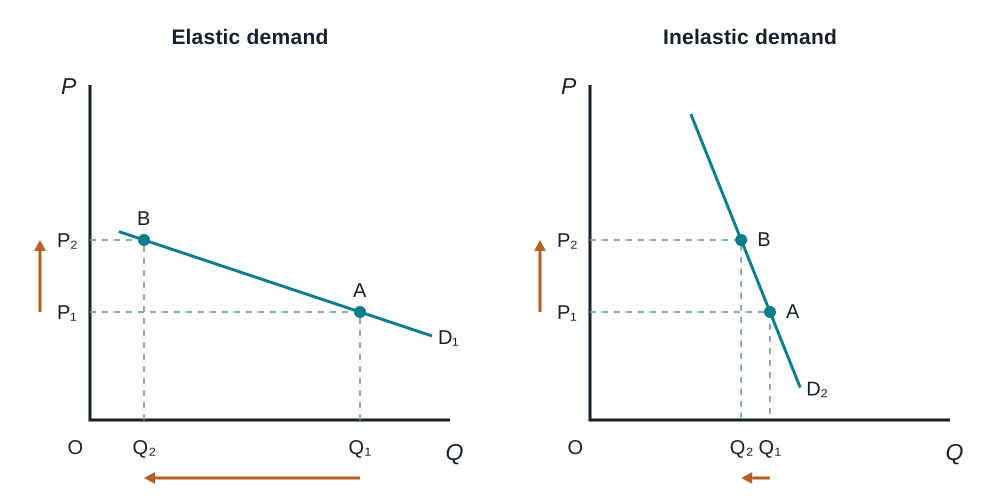
In the left panel, demand curve D₁ is relatively elastic. When price increases from P1 to P2, quantity demanded falls from Q1 to Q2. Notably, the fall in quantity demand is proportionately larger than the increase in price. This implies that PED > 1. In the right panel, demand curve D₂ is relatively inelastic. The same price rise (from P1 to P2) causes a movement along D₂ from A to B, but quantity demanded falls only slightly, from Q₁ to Q₂. The percentage fall in quantity demanded is smaller than the percentage rise in price, so PED < 1 and demand is inelastic.
Four main factors determine whether the demand for a good is relatively elastic or inelastic: the number and closeness of substitutes, the degree of necessity, the proportion of income spent on the good, and the length of time consumers have to respond to a price change.
Number and closeness of substitutes: Substitutes are "goods which can be used in place of each other". The more substitutes a good has, and the closer they are, the more elastic its demand. If the price of a good rises while the prices of its substitutes stay the same, the substitutes become relatively cheaper. Consumers can switch to them and still meet the same need, so quantity demanded of the good falls by a more than proportionate amount. For example, there are many brands of toothpaste that are close substitutes for each other. If the price of one brand rises, many consumers switch to another, so demand for a particular brand is price elastic, as in the left panel of Figure 1. If a good has few close substitutes, consumers have nothing to switch to when its price rises. For example, there is no close substitute for petrol for most car drivers, so quantity demanded falls less than proportionately to an increase in price, and demand is price inelastic - as in the right panel. How closely a good's substitutes match it also matters: Coca-Cola and Pepsi are closer substitutes than Coca-Cola and orange juice, so the demand for Coca-Cola responds more to a price rise when Pepsi is available.
Degree of necessity: Necessities are goods that consumers consider essential, so they cannot easily go without them. Luxuries are goods that are not essential. The more necessary a good, the less elastic its demand. When the price of a necessity such as basic food or medication rises, consumers still need it, so they continue to buy close to the same quantity and pay the higher price. Quantity demanded falls by a less than proportionate amount given an increase in price, so demand is price inelastic. When the price of a luxury, such as a diamond ring or a holiday abroad, rises, consumers can simply choose not to buy it or put off the purchase. Quantity demanded falls by a more than proportionate amount, given an increase in price, so demand is price elastic. A special case is an addictive good, such as cigarettes. The more addicted consumers are, the more they feel they need the good, so even a large price rise causes only a small fall in quantity demanded, and demand is very inelastic.
Proportion of income: The larger the proportion of a consumer's income spent on a good, the more elastic its demand. If a good takes up only a small proportion of income, such as a pen or a box of matches, even a large percentage rise in its price has only a small effect on the consumer's budget. Consumers may hardly notice the change, so quantity demanded falls only slightly and demand is price inelastic. If a good takes up a large proportion of income, such as a car, the same percentage rise in price means a large increase in the amount of money the consumer must pay. This leaves much less income for other goods, so consumers have a strong incentive to cut back, delay the purchase or look for a cheaper alternative. Quantity demanded falls by a more than proportionate amount, so demand is price elastic.
Time: The longer the period of time consumers have to respond to a price change, the more elastic demand becomes. Immediately after a price rise, consumers may be unable to change their behaviour, because they are tied to their habits or to the equipment they already own, and they may not yet know what alternatives are available. Over time, they can find information about substitutes, change their habits and replace their equipment. For example, if the price of heating oil rises, households can do little in the short run, because their homes are heated by oil-fired systems, so demand is inelastic. Over a longer period, they can switch to another heating system, such as gas, or improve their home's insulation. Quantity demanded then falls by much more, so demand becomes more elastic.