
Income elasticity of demand (YED) is defined as a measure of the responsiveness of the demand for a good or service to a change in income. It is calculated as YED = (% change in Qd) ÷ (% change in income). For normal goods, YED > 1, because demand rises when income rises. Necessities are goods that consumers consider essential, such as food, clothing and housing. Their demand increases as income increases, but the increase in demand is less than proportional to the rise in income, so 0 < YED < 1 and their demand is income inelastic. Luxury goods are goods that are not essential, such as jewellery and expensive cars. Services are intangible products, such as travel abroad, private education and eating in restaurants. For luxuries and many services, demand increases by more than the proportional rise in income, so YED > 1 and their demand is income elastic. In general, the YED of a necessity is less than that of a luxury good which is generally less than that of a service. This is the assumption we will make in this essay.
Figure 1 shows an Engel curve. The curve slopes upwards through three labelled points. Point A is at an income of $200 and a quantity of 2 units. Point B is at an income of $400 and a quantity of 6 units. Point C is at an income of $800 and a quantity of 8 units. The lower section, AB, is relatively flat and is labelled "YED > 1: luxuries and services". The upper section, BC, is relatively steep and is labelled "YED < 1: necessities". A dashed line extends AB backwards until it touches the vertical (income) axis at $100. A second dashed line extends BC backwards until it touches the horizontal (quantity) axis at 4 units.
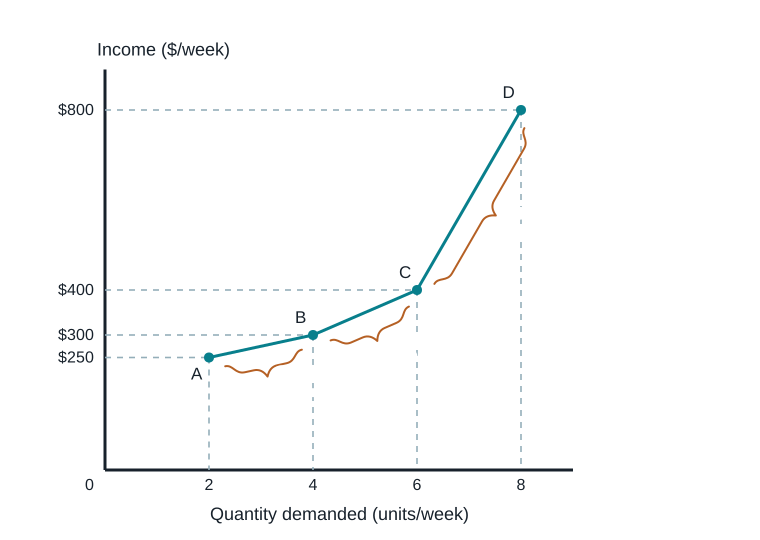
Along section AB in Figure 1, income doubles from $200 to $400, a 100% rise, while quantity demanded triples from 2 to 6 units, a 200% rise. YED = 200% ÷ 100% = 2. The percentage increase in quantity demanded is porportionately greater than the percentage increase in income, so in this range the good is income elastic, as luxuries and services are. Along section BC, income doubles again, from $400 to $800, a 100% rise, but quantity demanded rises only from 6 to 8 units, a 33% rise. YED = 33% ÷ 100% = 0.33. Quantity demanded rises by a less than proportionate amount, so in this range the good is income inelastic, as necessities are. Because income is on the vertical axis, a relatively flat section of an Engel curve shows quantity demanded rising a lot for a given rise in income, as with luxuries and services. A relatively steep section shows quantity demanded rising only a little, as with necessities.
The differences in YED between necessities, luxury goods and services can be explained by four reasons: how essential the good is, whether it is bought only once basic needs have been met, the different nature of services, and the income level of the consumer.
Necessity goods: Necessities satisfy basic needs, such as the need for food, clothing and shelter, so consumers buy them even when their incomes are low. When income rises, consumers may buy slightly more or better-quality food and clothing, but there is a limit to how much food a person can eat or how many coats they need. Each additional unit adds less satisfaction than the one before, so consumers spend only a small part of any extra income on necessities. The quantity demanded therefore rises by a less than proportionate amount, and YED is positive but less than 1. In developed countries the YED for food is only about 0.15 to 0.2. A 10% increase in income therefore leads to only a 1.5% to 2% increase in quantity demanded of food.
Luxury goods: Luxury goods are not essential, so consumers on low incomes spend little or nothing on them, because their income is used up by necessities. Once their basic needs are met, a rising share of each additional unit of income is left over for non-essential goods. Consumers can then afford goods such as jewellery, designer clothing or expensive cars, which they could not afford before. Because spending on luxuries starts from a low level and receives much of the extra income, the quantity demanded rises by a more than proportionate amount, and YED is greater than 1.
Services: Many services, such as travel abroad, private education, healthcare and eating in restaurants, are income elastic for similar reasons. They are mostly bought once basic needs have been met. In addition, once households already own the main manufactured goods they need, such as a car, a fridge and a television, extra income is increasingly spent on services rather than more physical goods. Services such as holidays, entertainment and restaurant meals can be consumed repeatedly, and higher-quality versions are always available, so demand for them keeps rising strongly as income grows. While many manufactured products have a YED greater than 1, many services have even higher YEDs. This is why, as an economy grows, the services sector expands at the expense of both agriculture and manufacturing.